
What Is a Power Adaptor?
A power adaptor is an essential electronic component that converts high-voltage AC (Alternating Current) from your wall socket into low-voltage DC (Direct Current) that your electronic devices can safely use.
In India, the standard wall socket supplies 230V AC. However, most electronic devices — cameras, routers, LED strips, IoT modules — require a much lower and regulated DC voltage to function correctly. This is where a power adaptor steps in.
When you look at any adaptor, you will see two critical values printed on its label — output voltage (V) and output current (A). The most common output voltages in consumer and commercial electronics are 12V and 5V. Understanding the difference between a 12V vs 5V power adaptor can save your devices from permanent damage and help you make the right purchasing decision.
12V vs 5V Power Adaptor — Key Differences at a Glance
| Feature | 12V Power Adaptor | 5V Power Adaptor |
|---|---|---|
| Output Voltage | 12 Volts DC | 5 Volts DC |
| Common Current | 1A, 2A, 3A, 5A | 1A, 2A, 3A |
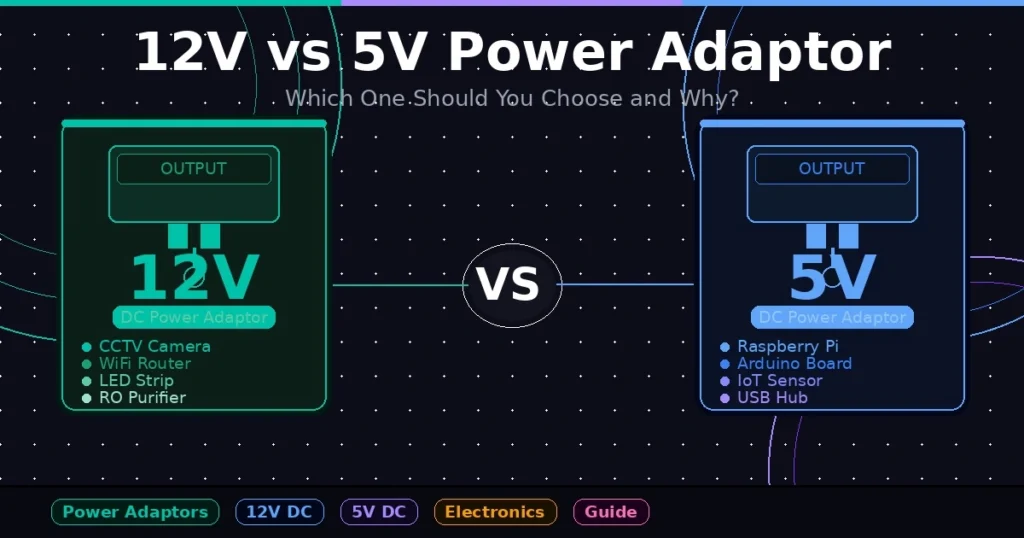
| Typical Devices | CCTV, Router, LED Strip | IoT, Raspberry Pi, USB Hub |
| Power Output | Higher | Lower |
| Connector Type | DC Barrel Jack (5.5×2.1mm) | DC Barrel or USB |
| Use Case | Surveillance, Networking, Lighting | Microelectronics, Automation |
What Is a 12V Power Adaptor?
A 12V power adaptor delivers a regulated 12 Volts DC output to power devices that require a higher DC voltage. It is one of the most widely used adaptors in residential, commercial, and industrial setups.
Common Applications of a 12V Power Adaptor
- CCTV security cameras — Most analog and IP cameras operate on 12V DC
- WiFi routers and network switches — Standard home and office routers use 12V
- LED light strips — 12V LED strips are the most popular choice for decoration and commercial lighting
- CATV cable TV amplifiers — Cable distribution equipment typically runs on 12V
- Access control systems — Door locks, card readers, and intercoms use 12V
- DVR and NVR recording systems — CCTV recording units require 12V power supply
- RO water purifiers — Most RO systems use a dedicated 12V DC adaptor for the pump motor
Technical Specifications of Teqvion 12V Adaptor
Teqvion’s 12V DC power adaptors are built using advanced Switch Mode Power Supply (SMPS) technology, which delivers stable output even under fluctuating input voltage.
| Specification | Details |
|---|---|
| Output Voltage | 12V DC ± 5% |
| Output Current | 1A / 2A / 3A variants |
| Input Voltage | 100–240V AC (Universal) |
| Frequency | 50/60 Hz |
| Connector | 5.5mm × 2.1mm DC Barrel Jack |
| Protection | OVP, OCP, Short Circuit, Thermal |
| Efficiency | >80% |
The built-in Over Voltage Protection (OVP), Over Current Protection (OCP), and Short Circuit Protection ensure that both the adaptor and your connected device remain safe under all operating conditions.
What Is a 5V Power Adaptor?
A 5V power adaptor delivers 5 Volts DC output — the same voltage level used by USB charging standards. It is ideal for low-power electronics, microcontrollers, and smart devices.
Common Applications of a 5V Power Adaptor
- Raspberry Pi and Arduino boards — Single-board computers and microcontrollers run on 5V
- USB hubs and USB-powered devices — Most USB-standard devices require 5V
- Smart home sensors and IoT modules — Home automation devices typically use 5V
- Small LED indicator displays — Low-power LED panels and segment displays
- Mini fans, cooling modules — Small DC fans in electronics enclosures
- Portable charging banks — 5V is the standard input/output for power banks
Technical Specifications of Teqvion 5V Adaptor
| Specification | Details |
|---|---|
| Output Voltage | 5V DC ± 5% |
| Output Current | 1A / 2A / 3A variants |
| Input Voltage | 100–240V AC (Universal) |
| Frequency | 50/60 Hz |
| Connector | 5.5mm × 2.1mm / USB Type-A |
| Protection | OVP, OCP, Short Circuit, Thermal |
| Efficiency | >>78% |
12V vs 5V Power Adaptor — Detailed Comparison
1. Voltage Level
This is the most fundamental difference in the 12V vs 5V power adaptor comparison. The 12V adaptor outputs 12 Volts DC while the 5V adaptor outputs 5 Volts DC. Connecting a 5V device to a 12V adaptor will immediately damage or destroy the device due to overvoltage. Similarly, connecting a 12V device to a 5V adaptor will cause it to malfunction or not power on at all.
Rule: Always match the output voltage of the adaptor exactly with your device’s required input voltage.
2. Current (Ampere) Rating
Current rating determines how much power the adaptor can supply. You should always choose an adaptor whose current rating is equal to or higher than what your device requires. For example, if your CCTV camera needs 12V 1A, you can use a 12V 2A adaptor safely — but never use a 12V 0.5A adaptor for a 1A device, as it will overheat and fail.
3. Power Output (Wattage)
- A 12V 2A adaptor delivers 24 Watts
- A 5V 2A adaptor delivers 10 Watts
For high-power devices like CCTV systems, LED strips, or routers with multiple connected devices, the 12V adaptor is the better choice because it delivers significantly more power.
4. Connector Type
Both 12V and 5V adaptors commonly use a 5.5mm × 2.1mm DC barrel jack. However, 5V adaptors are also available with USB Type-A connectors, making them compatible with USB-powered devices directly. Always verify the connector type before purchasing.
5. Heat Generation
12V adaptors generally generate slightly more heat than 5V adaptors due to the higher power conversion involved. Teqvion’s SMPS-based adaptors use thermal protection circuits to prevent overheating and ensure long operational life.
How to Read Your Device Label and Choose the Right Adaptor
Every electronic device has a label — usually on the bottom or back — that lists its power requirements. Here is how to read it:
Example label:
INPUT: 12V DC — 2A
This means your device needs exactly 12V DC and draws up to 2 Amperes of current. For this device you need a 12V adaptor with at least 2A output. A 12V 3A adaptor will also work perfectly fine — higher current rating adaptors are always safe to use.
Steps to choose the right adaptor:
- Locate the power label on your device
- Note the required output voltage — match it exactly
- Note the required current (A) — choose equal or higher
- Match the connector size and polarity (center positive is standard)
- Choose a quality brand with built-in protection circuits
When comparing a 12V vs 5V power adaptor for your specific use case, the device label will always give you the definitive answer.
Common Mistakes When Choosing a 12V vs 5V Power Adaptor
Many users make avoidable errors when selecting a power adaptor. Here are the most common mistakes:
1. Using the wrong voltage — The single most dangerous mistake. A 12V adaptor on a 5V device will permanently damage it within seconds.
2. Choosing a lower current rating — If your device needs 2A and you use a 1A adaptor, the adaptor will overheat, its lifespan will shorten drastically, and the device may behave erratically.
3. Ignoring protection features — Cheap adaptors without OVP, OCP, or short circuit protection can damage your expensive devices during voltage spikes or power surges.
4. Using a non-universal adaptor — In India, voltage fluctuations are common. Always choose an adaptor with a 100–240V AC universal input range so it handles fluctuations without failing.
5. Mismatching the connector — A physically fitting connector does not always mean it is the correct voltage. Always verify both the connector size and the output voltage.
Why Teqvion Power Adaptors Are a Reliable Choice
Teqvion is a Kolhapur-based power electronics brand that manufactures and supplies high-quality 12V DC adaptors, 5V DC adaptors, and RO adaptors for residential, commercial, and industrial use across Maharashtra and India.
Every Teqvion power adaptor is engineered with:
- SMPS Technology — High efficiency, low heat, stable output
- Universal Input (100–240V AC) — Works across all Indian power conditions
- Built-in Protection — OVP, OCP, short circuit, and thermal protection
- Long Operational Life — Premium components for consistent performance
- CE/RoHS Compliance — Meets international quality and safety standards
Whether you need a 12V adaptor for your CCTV system, a 5V adaptor for your IoT project, or an RO adaptor for your water purifier, Teqvion has a reliable solution for every application.
For bulk orders, dealer pricing, or product specifications, contact the Teqvion team at contact@teqvion.in or call +91 83087 07020.
FAQs — 12V vs 5V Power Adaptor
Q1. Can I use a 12V adaptor for a 5V device?
No. Using a 12V adaptor on a 5V device will immediately damage or destroy the device due to overvoltage. Always match the voltage exactly.
Q2. Can I use a 5V adaptor for a 12V device?
No. A 5V adaptor cannot power a 12V device. The device will either not turn on or malfunction. The voltage must match the device requirement.
Q3. Is it safe to use a higher ampere adaptor than required?
Yes, it is completely safe. If your device needs 1A and you use a 2A adaptor of the same voltage, the device will only draw the current it needs. The adaptor will not force extra current into the device.
Q4. What happens if I use a cheap adaptor without protection?
Adaptors without Over Voltage Protection (OVP) or Short Circuit Protection can send voltage spikes to your device during power surges, permanently damaging it. Always use adaptors with built-in protection circuits.
Q5. How do I know if my router needs a 12V or 5V adaptor?
Check the label on the bottom of your router. It will clearly mention the required input voltage — most home routers use 12V DC.
Q6. Where can I buy a reliable 12V or 5V power adaptor in Kolhapur?
Teqvion Pvt. Ltd. in Kolhapur supplies high-quality 12V and 5V DC adaptors for retail and bulk purchase. Contact contact@teqvion.in or call +91 83087 07020.
Q7. What is the difference between a power adaptor and a charger?
A charger is specifically designed to charge batteries and includes charge control circuits. A power adaptor simply converts AC to DC to power a device directly. Both use similar conversion technology but serve different purposes.