
What Is a CCTV Power Supply?
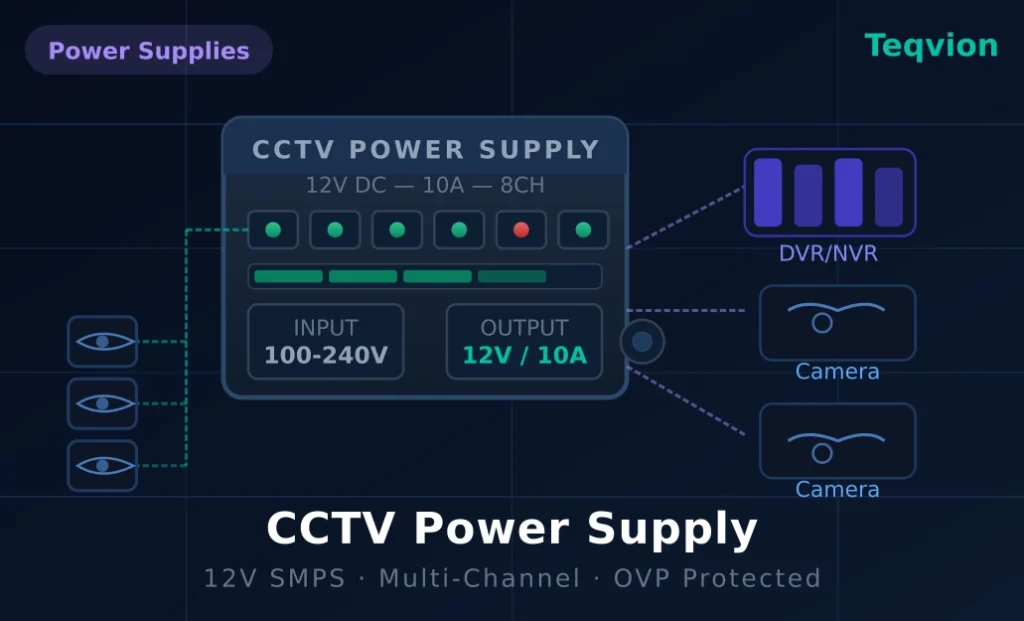
A CCTV power supply is a dedicated Switch Mode Power Supply (SMPS) unit that converts 230V AC mains electricity into regulated 12V DC power required by CCTV cameras, DVR units, and NVR systems.
Every surveillance camera — whether analog, AHD, HD-CVI, or IP — requires a stable and clean 12V DC input to operate correctly. Fluctuations, voltage drops, or dirty power can cause cameras to reboot, display grainy footage, or fail permanently. This is exactly why a high-quality CCTV power supply is not optional — it is the single most important component in any surveillance installation.
Unlike a generic adaptor, a dedicated CCTV power supply is designed to power multiple cameras simultaneously from a single unit, with separate fused outputs for each channel, making installation cleaner and troubleshooting much easier.
Why the Right CCTV Power Supply Matters
Many installers make the mistake of using cheap, unrated power supplies to cut costs. This is a serious error. A low-quality CCTV power supply causes:
- Cameras going offline randomly due to voltage drops
- Blurry or noisy video footage caused by unstable power
- DVR and NVR recording failures due to insufficient current
- Overheating and fire risk from underpowered supply units
- Shortened camera lifespan due to inconsistent power input
Investing in a properly rated, protected CCTV power supply from day one saves significant repair, replacement, and callback costs down the line.
Key Specifications of a CCTV Power Supply
When selecting a CCTV power supply, always check these critical specifications:
| Specification | What It Means |
|---|---|
| Output Voltage | Must be 12V DC — standard for all CCTV cameras |
| Output Current | Total ampere capacity of the unit |
| Number of Channels | How many camera outputs the unit supports |
| Input Voltage | Should be 100–240V AC for Indian conditions |
| Per-Channel Fuse | Individual fuse protection per output channel |
| Enclosure | Metal box for better heat dissipation and durability |
| Protection | OVP, OCP, Short Circuit, Thermal Protection |
Standard Teqvion CCTV Power Supply Specifications
| Specification | Details |
|---|---|
| Output Voltage | 12V DC ± 5% |
| Total Output Current | 5A / 10A / 20A variants |
| Number of Channels | 4 / 8 / 16 channel variants |
| Input Voltage | 100–240V AC Universal |
| Per-Channel Current | 1A per channel (fused) |
| Enclosure | Metal box with lock |
| Protection | OVP, OCP, Short Circuit, Thermal |
Single Channel vs Multi-Channel CCTV Power Supply
One of the most common questions during a CCTV installation is whether to use individual single-channel adaptors for each camera or a centralised multi-channel CCTV power supply unit.
Single Channel Adaptor
A single-channel adaptor powers one camera per unit. While simple, this approach creates cable clutter, makes fault-finding difficult, and increases the risk of a failure going unnoticed since each unit operates independently.
Best for: 1 to 2 camera setups, temporary installations, or outdoor cameras located far from a central distribution point.
Multi-Channel CCTV Power Supply
A multi-channel CCTV power supply box distributes regulated 12V DC power to 4, 8, or 16 cameras simultaneously from a single centrally located unit. Each output channel has its own fuse — so if one camera develops a short circuit, only that channel trips and the remaining cameras stay online.
Best for: Any professional CCTV installation with 4 or more cameras, commercial premises, warehouses, offices, retail shops, and residential complexes.
The multi-channel CCTV power supply is the professional standard for a very good reason — it is reliable, organized, and easy to maintain.
How to Calculate the Right Ampere Rating
This is where most first-time buyers go wrong. Undersizing your CCTV power supply is one of the most common causes of surveillance system failures.
Step 1 — Find your camera’s current draw Most standard CCTV cameras draw between 300mA to 800mA (0.3A to 0.8A) each. IR cameras with night vision draw slightly more — up to 1A per camera when IR LEDs are fully active.
Step 2 — Add up total current Multiply the number of cameras by the maximum current draw per camera.
Example calculation:
- 8 cameras × 1A each = 8A total requirement
- Add 20% safety buffer = 8A × 1.2 = 9.6A minimum
- Choose a 10A CCTV power supply for this setup
Step 3 — Never run at 100% load Always choose a CCTV power supply rated 20–30% above your calculated requirement. Running any power supply at full rated load continuously causes overheating and significantly shortens its operational life.
Quick Reference:
| Number of Cameras | Recommended CCTV Power Supply |
|---|---|
| 1–4 cameras | 5A, 4-channel unit |
| 5–8 cameras | 10A, 8-channel unit |
| 9–16 cameras | 20A, 16-channel unit |
CCTV Power Supply Protection Features You Must Look For
A quality CCTV power supply must include the following protection features. Never compromise on these:
Over Voltage Protection (OVP) — Automatically shuts down output if voltage exceeds the rated level, protecting all connected cameras from voltage spikes.
Over Current Protection (OCP) — Limits output current to prevent damage to cameras and internal components when current demand spikes.
Short Circuit Protection — If any camera cable develops a short circuit, the supply cuts power to that channel immediately without affecting other channels or causing fire risk.
Thermal Protection — Automatically reduces output or shuts down if internal temperature exceeds safe operating limits — critical in Indian summers where ambient temperatures can exceed 45°C.
Per-Channel Fusing — Individual resettable or replaceable fuses on each output channel. When one camera circuit trips, only that channel is affected.
Teqvion’s CCTV power supply units include all of the above protection features as standard, ensuring long-term reliability in demanding real-world conditions.
Common Problems Caused by a Poor CCTV Power Supply
If your surveillance system is showing any of the following symptoms, a failing or undersized CCTV power supply is almost always the root cause:
- Cameras turning off and on repeatedly — classic sign of voltage drop under load
- One or more cameras showing black screen — per-channel fuse blown or channel overloaded
- DVR showing “no signal” for specific cameras intermittently — unstable 12V output
- Cameras producing grainy or noisy footage — power ripple from low-quality SMPS
- Supply unit running hot to the touch — operating at or beyond rated capacity
- Burning smell from the supply box — imminent failure, replace immediately
In all these cases, replacing the CCTV power supply with a properly rated Teqvion unit resolves the issue immediately.
Why Choose Teqvion CCTV Power Supply?
Teqvion is a Kolhapur-based power electronics manufacturer supplying high-quality CCTV power supply units to installers, system integrators, and businesses across Maharashtra and India.
Every Teqvion CCTV power supply is built with:
- Robust metal enclosure — Better heat dissipation, theft-proof locking, suitable for wall mounting in any environment
- Universal 100–240V AC input — Handles Indian voltage fluctuations without failure
- Per-channel fused outputs — Individual channel protection for professional-grade installations
- Full protection suite — OVP, OCP, short circuit, and thermal protection built in as standard
- 4, 8, and 16 channel variants — Right sizing for every installation from small homes to large commercial premises
- Long operational life — Premium SMPS components rated for continuous 24×7 operation
For CCTV installers and security system dealers looking for a reliable CCTV power supply supplier in Kolhapur and Maharashtra, Teqvion offers competitive bulk pricing, consistent stock availability, and dedicated technical support.
Contact Teqvion at contact@teqvion.in or call +91 83087 07020 for product specifications, bulk pricing, and dealer enquiries.
FAQs — CCTV Power Supply
Q1. What voltage does a CCTV camera require?
Almost all standard CCTV cameras — analog, AHD, HD-CVI, and TVI — require 12V DC power input. Always verify your specific camera’s label before choosing a CCTV power supply.
Q2. Can I use a regular 12V adaptor instead of a dedicated CCTV power supply?
For a single camera, a quality 12V adaptor can work. However, for 4 or more cameras, always use a dedicated multi-channel CCTV power supply with per-channel fusing for safety and reliability.
Q3. How many cameras can a 5A CCTV power supply run?
A 5A CCTV power supply can reliably run 4 cameras drawing up to 1A each, with some headroom. For IR cameras at night, ensure you account for the higher current draw when IR LEDs activate.
Q4. Why does my CCTV power supply get hot?
Heat is normal during operation. However, if the unit is too hot to touch, it is likely undersized for your camera load or operating in a confined space without ventilation. Upgrade to a higher-ampere rated CCTV power supply.
Q5. Where can I buy a Teqvion CCTV power supply in Kolhapur?
Contact Teqvion Pvt. Ltd. directly at contact@teqvion.in or call +91 83087 07020 for retail and bulk purchase of Teqvion CCTV power supply units in Kolhapur and across Maharashtra.
Q6. Where can I buy a Teqvion inverter LED bulb in Kolhapur?
Yes. Teqvion supplies 4-channel, 8-channel, and 16-channel CCTV power supply units suitable for small residential systems to large commercial surveillance installations.